Supply chain and logistics recruitment covers four talent pools that behave very differently. Warehousing and despatch roles can often be filled in days. Freight and transport roles take one to four weeks because licences and compliance narrow the field. Supply chain planning and management roles are genuinely scarce and searches commonly run four to eight weeks. Most hiring frustration in this sector comes from applying warehousing timeframes to planning roles. The agencies worth using will tell you which pool your vacancy sits in before they quote.
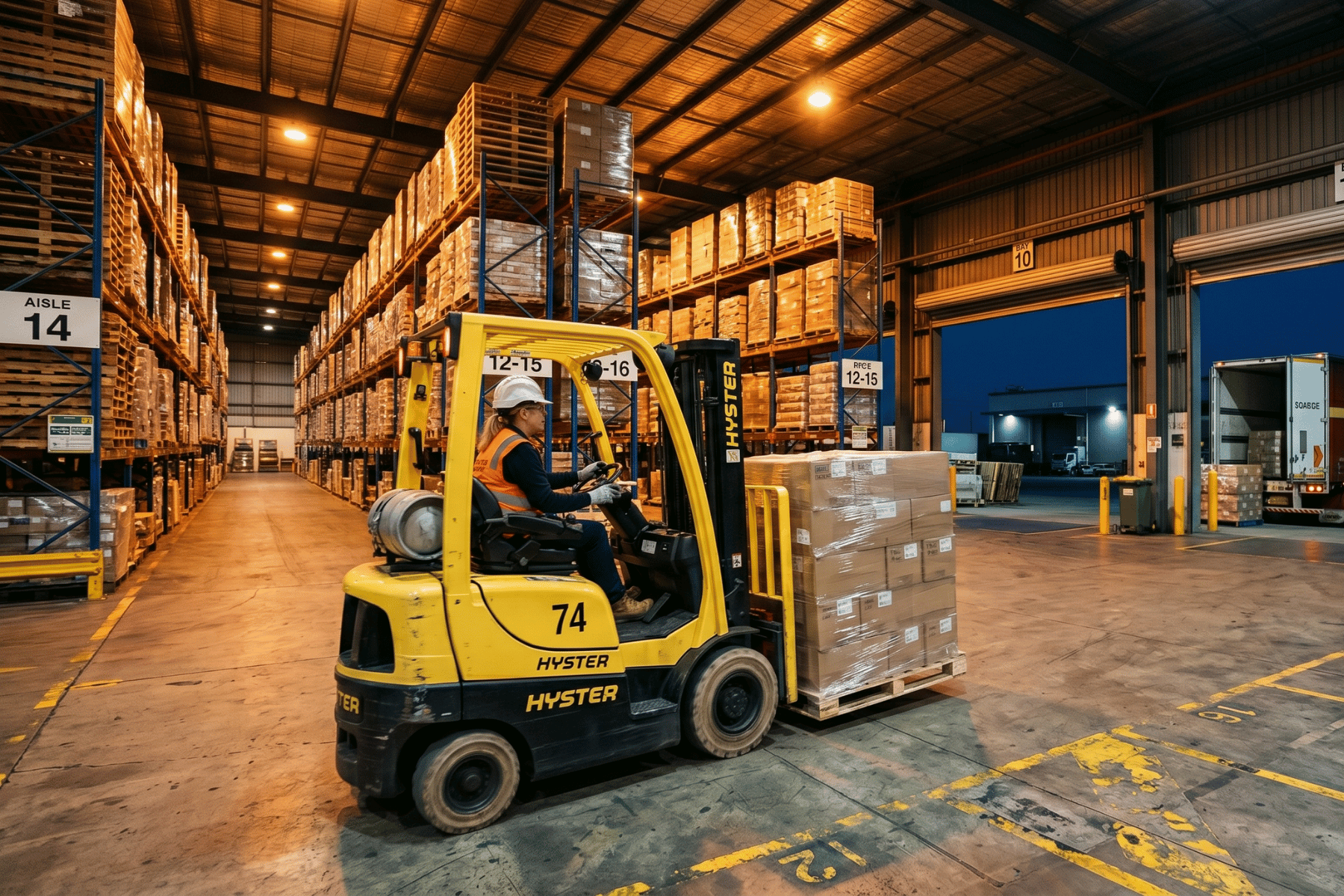
It is 5am, the warehouse lights are buzzing on, and you are staring at a roster that no longer matches reality. Key seats on the forklift are empty. A driver has called in sick again. Your production schedule is in pieces before the day has started.
That is not a recruitment problem you can solve by posting another ad. This guide sets out what each part of the supply chain talent market actually looks like, how long each type of role realistically takes to fill, and how to brief an agency so you get people who stay.
What does a supply chain recruitment agency do?
A supply chain recruitment agency sources, screens and supplies the people who move goods: warehouse and despatch staff, freight and transport operators, and the planning and management roles that coordinate them.
A competent one does four things:
- Maintains an active local pool rather than starting a search from zero when you call.
- Verifies what actually matters: licences, tickets, right to work, and a genuine safety record rather than a claimed one.
- Screens for the environment, not the résumé. Chilled or ambient, 12-hour rotating or straight days, high-throughput or low-volume batch. These decide whether a placement survives a month.
- Carries the compliance load where the workers are agency-employed: payroll, superannuation, workers compensation and induction.
The distinction that matters commercially is between an agency that fills a vacancy and one that understands why the vacancy keeps recurring.
Which supply chain and logistics roles are we hiring for?
Four functions, four very different markets.
Function | Typical roles | Realistic time to fill |
Warehousing | Storepersons, pickers and packers, forklift operators, despatch officers, warehouse supervisors | Days to 2 weeks |
Freight | Freight sorters, container handlers, freight forwarding specialists, transport planners | 1 to 3 weeks |
Transport | Truck drivers, courier drivers, logistics coordinators, fleet managers | 1 to 4 weeks |
Supply chain | Supply planners, inventory managers, distribution centre managers, supply chain managers | 3 to 8 weeks |
We recruit across all four. That includes warehouse recruitment and licensed forklift operators, freight recruitment including freight forwarding specialists, logistics and transport recruitment covering truck drivers, and supply chain recruitment up to inventory managers and distribution centre managers.
How long does it take to fill a supply chain role?
Use the table above as your planning baseline, and understand what moves the numbers.
What makes it faster: an active pool in your catchment, a roster pattern that is common in the market, a rate at or above local benchmarks, and a brief given in the first conversation rather than the third.
What makes it slower: a licence or ticket requirement, an unusual shift pattern, a site that is hard to reach without a car, a rate set below the market, and a role that is really two roles bolted together.
The practical consequence is that the same job ad will fill a picking role in three days and leave a demand planner vacant for two months. Budget the time accordingly, and be suspicious of anyone who promises otherwise. Where the requirement is genuinely urgent, it is worth reading how we fill roster gaps in 48 hours and what that actually requires from both sides.
Why is supply chain talent so hard to find right now?
The shortage is not uniform, and treating it as one problem is why searches stall.
Entry-level warehouse labour is available in Sydney’s industrial corridors if you can offer a competitive rate and a workable roster. If you cannot fill these roles, the constraint is usually the offer rather than the market.
Licensed and ticketed roles are tight. Forklift, heavy vehicle and dangerous goods credentials take time to obtain, and the people who hold them have options. An aging workforce compounds it: experienced operators with heavy vehicle licences are retiring faster than they are being replaced.
Planning, inventory and distribution management roles are genuinely scarce. The skill set takes years to build and the people who have it are rarely on the open market. These are search assignments, not advertising exercises.
Two other forces sit underneath all of it. Every time a large distribution centre opens on the edge of a town, it pulls dozens of workers out of the local market at once. And candidate expectations have shifted: skilled operators want fair pay, safe conditions and reliable hours, and if a site is disorganised or unsafe they will walk down the road to a competitor.
The hidden costs of an unreliable workforce
Poor hiring does its real damage quietly, on the P&L.
Relying on a skeleton crew to cover empty shifts creates a cycle. Your best people pick up the slack, overtime costs climb, and fatigue sets in. A tired worker on a busy loading dock is a serious work health and safety exposure, not just a productivity one.
When you lack skilled operators, continuity breaks. Pallets sit idle because nobody qualified can move them. Trucks miss delivery windows. Customers escalate.
Then there is retraining. You spend three days teaching a casual the layout of your cool room and the quirks of your inventory system, and they are gone by Thursday. Constant retraining drains productivity and corrodes floor morale, and it is the cost operations managers most consistently underestimate.
If your operation touches road transport at all, there is a compliance dimension too. Chain of Responsibility duties around fatigue, load restraint and scheduling sit with you as well as with the operator, and agency shortcuts land on your side of the ledger.
What separates a specialist from a generalist agency?
Four things, and none of them show up in the pitch.
They ask about the roster before the rate. Shift tolerance is the strongest single predictor of whether an industrial placement survives its first month. An agency that does not ask specific, uncomfortable questions about night shift, early starts and weekend work will send you people who leave.
They have walked a site like yours. Line speed, lifting, temperature, noise, and the distance from the car park to the dock all change who succeeds in a role. None of it is on a résumé.
They can name the pool your role sits in. A specialist will tell you before quoting whether you are looking at a three-day fill or a six-week search. A generalist quotes the same timeframe for both.
They raise compliance before you do. Licence verification, right to work, WHS induction and Chain of Responsibility. If safety does not come up until you mention it, they have not thought about your exposure.
Supply chain recruitment in Sydney
Sydney’s supply chain employment is concentrated in a few corridors, and the geography drives everything.
Western Sydney around Eastern Creek, Erskine Park, Wetherill Park and Smithfield, and South Western Sydney around Ingleburn, Prestons, Moorebank and Smeaton Grange, hold the densest concentration of distribution and freight operations in the state. Silverwater, Chullora and Revesby carry older established estates.
Because most shifts start between 5am and 6am, the practical catchment for any site is narrow. Public transport does not serve those start times well, so the realistic labour pool is people who can drive to you in under about 30 minutes. An agency with genuine depth in those corridors can crew a site from workers who live nearby and will still be there in three months. An agency working from a national database will fill the role once and lose the person to the commute.
The same logic applies in reverse if you operate interstate. Ask specifically about coverage in each location rather than assuming a national brand means a national pool.
How to brief an agency so you get the right people
Most disappointing placements trace back to an incomplete brief. Cover these seven points in the first conversation and the shortlist improves immediately.
- The roster, precisely. Start time, shift length, rotation pattern, weekend requirement.
- The physical reality. Temperature, lifting, standing time, noise, equipment.
- Licences and tickets that are genuinely required, separated from ones that are merely nice to have.
- The rate, and whether it sits at, above or below local benchmarks. If it is below, say so, because it changes the search.
- Site access. Parking, public transport, how far the walk from the gate is.
- What good looks like. Name someone currently in the role who performs well, and describe why.
- The real deadline, and what happens if it is missed.
Be brutally honest about the difficult parts. If the role is a minus-22 freezer on a 5am start, say it in the first conversation. Every candidate who accepts on incomplete information is a resignation waiting to happen in week two. Honesty at brief stage is the cheapest retention tool available.
If your requirement extends into the office side of logistics, our guide to hiring customer service teams in logistics covers that market.
Stop the bottlenecks and secure your production schedule
When your production does not stop, neither should your staffing.
You deserve a partner who understands the industrial sector, knows the local market, and delivers vetted people who arrive ready to work safely. We help you retain staff by placing the right people in the seat in the first place. When you start with a candidate whose skills and attitude match the operation, the retention battle is already half won.
Take back control of your roster. Book a meeting or schedule a phone call with us to discuss your specific operational bottlenecks, and we will give you a straight assessment of your current staffing strategy.
Frequently asked questions
What does a supply chain recruitment agency do?
A supply chain recruitment agency sources, screens and supplies staff across warehousing, freight, transport and supply chain planning. That includes maintaining an active local talent pool, verifying licences, tickets and right to work, screening for the physical and shift realities of the role, and, where workers are agency-employed, carrying payroll, superannuation, workers compensation and induction.
How long does it take to fill a supply chain role?
It depends on the pool. Warehousing and despatch roles can often be filled within days to two weeks. Freight roles typically take one to three weeks and transport roles one to four, because licences narrow the field. Supply chain planning and management roles commonly run three to eight weeks because the skill set is scarce.
What is the difference between logistics and supply chain recruitment?
Logistics recruitment generally covers the physical movement and storage of goods: warehousing, freight, transport and despatch. Supply chain recruitment extends to the planning and management functions that coordinate them, such as demand and supply planners, inventory managers and distribution centre managers. The two markets behave very differently on availability and time to fill.
Which supply chain roles are hardest to fill in Australia?
Planning, inventory and distribution management roles are the scarcest, because the skill set takes years to build and those people are rarely on the open market. Licensed and ticketed operational roles, including heavy vehicle and dangerous goods, are also tight due to an aging workforce. Entry-level warehouse labour is generally available where the rate and roster are competitive.
How do I choose a logistics recruitment agency?
Ask whether they will visit your site before briefing candidates, how they screen for shift tolerance and physical capability, what their retention rate is on comparable placements, and whether they can tell you which talent pool your role sits in before quoting a timeframe. Agencies without genuine sector depth quote the same timeframe for a picker and a demand planner.
Why do warehouse staff keep leaving after a few weeks?
Most early turnover traces back to an incomplete brief. If the temperature, lifting, roster or commute were not described accurately before the person accepted, they leave once they experience it. Brief the difficult parts honestly, ask the agency to supply a consistent named crew rather than whoever is available, and give feedback within the first shift rather than at invoice stage.